
Mobile payment optimisation for travel bookings

Consumers are increasingly using mobile devices to plan their next trip. However, while mobile now drives a higher number of bookings, users convert at just 1.4% , less than half the desktop rate of 3.9%. This significant performance gap results in millions of pounds in lost revenue for online travel agents (OTAs) every year.
With mobile visits dominating travel site traffic, optimising the checkout experience has become non-negotiable for OTAs. The question is no longer whether to fix mobile payments, but how quickly you can close the gap before your competitors do.
How much potential revenue is being lost?
If you have a travel site with 100,000 monthly mobile visitors, a 1.4% conversion rate, and an average booking value of £1,800, your monthly revenue is £2,520,000.
If that same mobile traffic converted at the desktop rate of 3.9%, your monthly revenue would jump to over £7 million.
However, as desktop traffic and conversions continue to decline slowly, mobile-first optimisation is becoming the highest-impact growth tactic for travel brands.
Why mobile checkout impacts travel bookings
Holiday bookings are complex transactions. Small screens amplify every point of friction. Often, several factors combine to create a poor mobile checkout experience.
Manual card entry is the primary killer. Typing a 16-digit card number, expiry date, and CVV on a phone screen is tedious and error-prone. Autocorrect interferes with numeric fields. Users switch between apps to retrieve card details, breaking session flow. In a high-value category like travel, where a typo could mean a £2,000 mistake, each additional form field drives abandonment.
Trust concerns run deeper on mobile. Users feel exposed when entering substantial payment details on a phone. Smaller screens make it harder to display the security badges and trust signals that reassure desktop buyers. This often results in customers abandoning a purchase halfway through, perhaps intending to pick up where they left off later on from a desktop. But in many instances, they begin a search all over again, and that booking is now lost forever.
Technical issues see many payments fall at the final hurdle. Mobile page loads are slower when there is a poor network or Wi-Fi connection, leading to timeouts. Mandatory 3D Secure redirects can interrupt sessions in mobile browsers. If the keyboard obscures a critical form field or autofill fails, most likely, the booking will be abandoned.
The digital wallet solution: Apple Pay, Google Pay, PayPal, and Click to Pay
The most direct way to close the conversion gap is to remove manual entry entirely, and on mobile, there is a very simple solution to this problem.
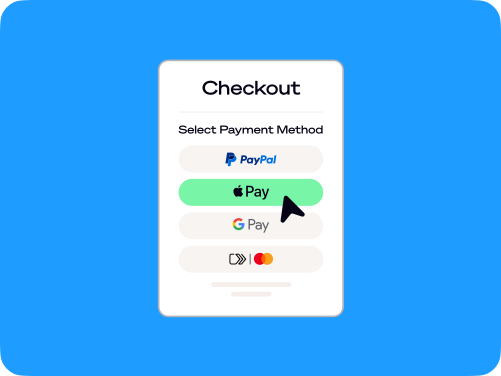
Digital wallets solve mobile checkout's core issue: they allow users to complete purchases with a single tap or biometric scan. Card details and billing addresses are pre-stored and authenticated by the device. The result is faster, more secure, and a dramatically simpler checkout experience for users.
Market adoption reflects this. 60% of UK adults now use at least one mobile wallet, and digital wallets are projected to account for 68% of all online purchases by 2030 . For travel merchants, wallets can reduce checkout time from several minutes to just 15 seconds.
To capture the full market, you need four essentials:

Implementation options range from hosted payment pages for rapid deployment to API integration for granular control over button placement and user journey.

Additional mobile optimisation tactics
Digital wallets deliver the biggest conversion lift, but other tactics can further reduce friction. Mobile-optimised Buy Now, Pay Later (BNPL) options work particularly well for high-ticket travel purchases. Displaying "Split the cost of your holiday" on a mobile screen also helps to reduce the psychological weight for customers making a large upfront payment.

Form field reduction is critical on smaller devices. Use postcode lookups for addresses and smart defaults (pre-selecting the UK as the country for domestic users). Correct HTML attributes enable browser autofill, so even when wallets aren't used, the browser can assist.
Speed is crucial. Payment pages should load in under two seconds on 4G. This requires image optimisation, lazy-loading non-critical scripts, and ensuring 3D Secure 2.0 flows are biometric-enabled and redirect-free.
Measuring and optimising performance
Closing the gap requires tracking conversion rates across a number of payment KPIs.
Geographic and payment method alignment
Conversion rates vary dramatically by user location and available payment methods. UK domestic bookers may convert well with cards and Apple Pay, but travellers from other countries will want to pay using methods familiar to them. Track conversion by user country and cross-reference with payment methods offered. If you're losing German mobile traffic, the absence of local payment methods may be the culprit, not your mobile UX.
Currency presentation
How you display prices impacts conversion. Dynamic currency conversion can improve conversion for international bookers who want to see their home currency, but poor implementation (unclear exchange rates, hidden fees) destroys trust. Test showing local currency by default based on IP or browser settings, and measure conversion impact by booking origin.
Time-based patterns
Mobile conversion behaviour changes throughout the day and week. Mobile traffic peaks during commuting hours and lunch breaks, but conversion rates are often higher in the evening when users have time to complete bookings. Weekend mobile traffic may convert differently than weekday. Segment your data by day of week and time of day to identify when mobile users are most likely to complete purchases, and ensure payment page load speeds and support availability are maximised during those windows.
Alternative Payment Method performance
BNPL options like Klarna or PayPal Pay in 3 may significantly boost conversion for younger mobile users booking high-value trips, while having minimal impact on business travel bookings. Track payment method preference by age demographic, booking value, and destination type (domestic weekend vs international holiday), as not all payment methods deliver equal ROI across all segments. Additionally, if iOS users convert significantly better than Android users, you may have a Google Pay integration issue or a mobile layout problem on specific browsers that needs to be addressed.
Authorisation rates and payment routing
A payment method is useless if transactions decline. Track authorisation rates by payment method, issuing bank country, and card type. If Visa transactions from UK mobile users decline at 8% while Mastercard declines at 4%, your payment routing strategy needs attention. Smart payment routing (sending transactions through the acquirer most likely to approve them) can recover 2-5% of failed mobile payments.
Booking value thresholds
Conversion behaviour changes at specific price points. A £100 a night booking for a budget hotel may convert easily on mobile, while a £5,000 long-haul holiday triggers "I'll finish this on desktop" behaviour. Identify your mobile conversion drop-off threshold and test trust-building tactics (prominent security badges, travel insurance options, flexible cancellation terms) specifically for high-value mobile bookings. Segment data by booking value to reveal whether high-value long-haul bookings require different trust signals than low-cost weekend breaks.
New vs returning customers
First-time mobile visitors convert at lower rates than returning customers who've saved payment details. Track this split and measure the impact of guest checkout options, tokenized card storage, and account creation incentives. If returning mobile users convert at near-desktop rates, your problem is trust-building for new visitors, not checkout UX.
A/B testing priorities
A/B testing is essential. Test payment button order, trust signal placement, and the impact of providing express checkout options directly from the cart page. Segment all tests by the factors above. A change that works for UK domestic bookings may hurt conversion for international travellers.
The business case for investment
Mobile payment optimisation typically delivers the highest ROI of any digital project. For a site with 70,000 monthly mobile visitors, even a 10% conversion improvement generates an additional £450,000 in monthly revenue. Because digital wallet implementation is relatively fast, often taking just weeks, payback periods are short.
Closing the gap
By adopting a mobile-first strategy centred on digital wallets, online travel agents can stop losing the majority of their traffic to avoidable frustration. As mobile continues to dominate search, only merchants who master mobile checkout will thrive in the current travel landscape.
Want to see how leading UK travel companies are optimising their checkouts? Our competitive benchmark reveals complete payment method strategies, including digital wallet deployment and mobile optimisation approaches.