Get paid anywhere, anytime: how small businesses are using payment links

For years, small businesses have mostly relied on a handful of ways to get paid, and cards and bank transfers, while common, both come with their own frustrations.
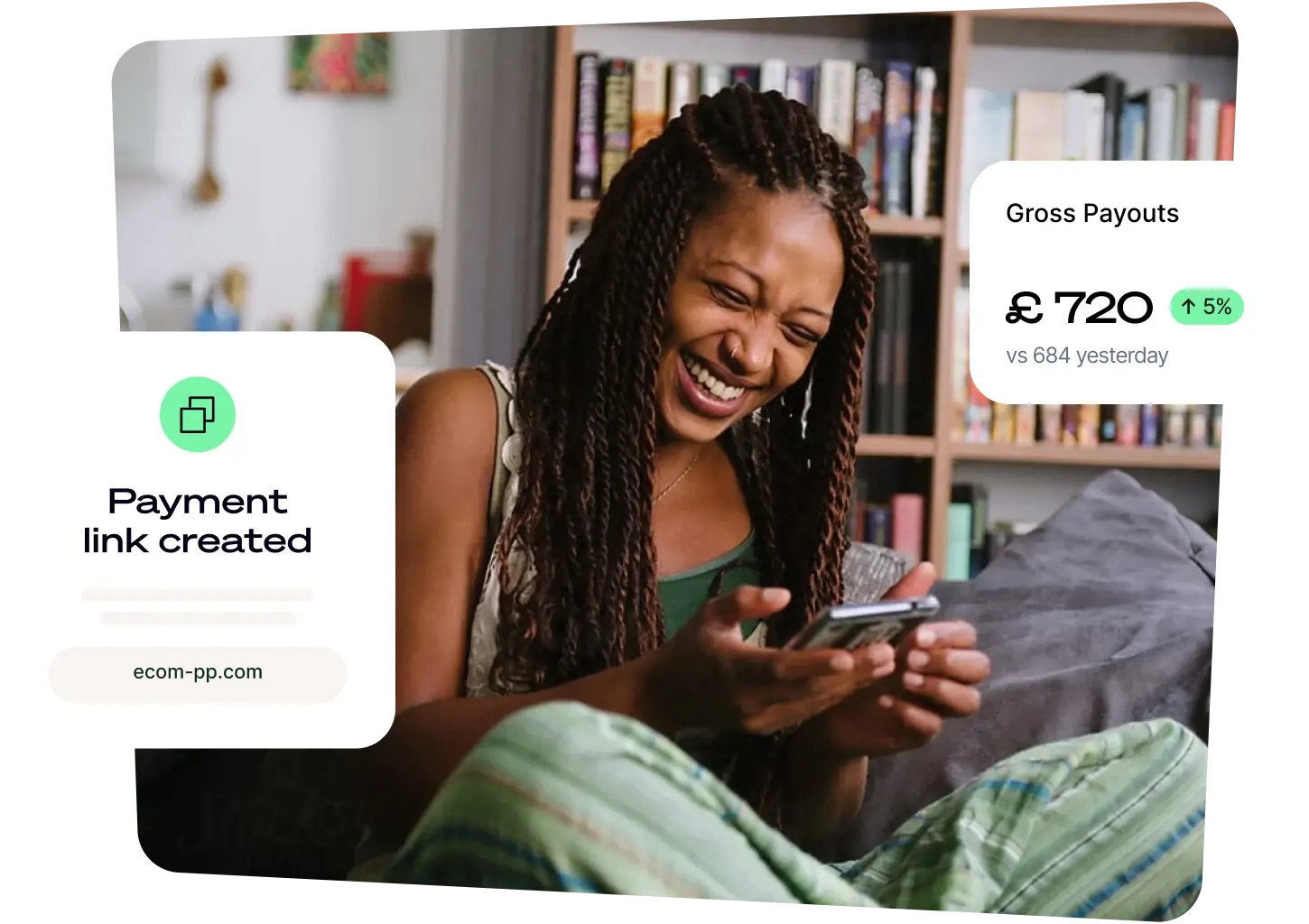
Getting paid shouldn't mean chasing invoices by email, wrestling with a temperamental card reader, or waiting for a bank transfer to clear. A payment link solves all three: send it in seconds, let the customer pay however suits them, and watch the money land in your merchant dashboard, with no extra admin required.
Whether that's an invoice for a big-ticket bespoke order, a deposit and balance split across a project, or a one-off job, the examples below show how much friction that removes for both sides.
We sat down with a focus group of consumers to talk through their recent payment frustrations, and find out just how much smoother payment links make things for everyone involved.
How would consumers prefer to make these payments?
In our consumer focus group, payment links were the most popular option.
- Payment links
- 55.48%
- QR code
- 20.49%
- Bank transfer
- 24.03%
Customer payment experiences and pain points
When it comes to making payments for major life events, like getting married or renovating a home, there are often many suppliers involved, all of which request payment in different ways.
Consumers may be late paying invoices if they don’t have their card or something to jot down your bank account information to hand. The ‘I’ll do it when I get a second’ can turn into days, then weeks, and maybe even months if you don’t keep on top of things.
Not only does chasing payments create more admin for you, but it can also frustrate the customer. People want to be able to settle in the fastest and easiest way possible.
Mobile card readers (which allow you to take payments on your phone) are a very convenient way to collect payments from customers - but only when they work. Unfortunately, network failures, device connection problems, a low or completely dead phone battery, or a customer’s card being declined, are all more common than you think.
Here’s what our focus group shared with us.
Customer pain point 1: Paying invoices
"When we were planning our wedding, it became difficult to keep track of invoices pretty quickly. Emails were piling up from venues and suppliers, and it wasn't just a hassle to search through everything to check whether an invoice had even been raised, but also to keep track of deposits and what was still outstanding. Then, once we'd finally tracked everything down and were ready to pay, setting up a bank transfer for each individual invoice was time-consuming, and we still had to contact them to confirm the payment had actually landed."
Customer pain point 2: Deposits and staged payments
“It's easy to forget how much buying isn't 'off the shelf,' and once you're mid-renovation you notice it everywhere. We recently had a carpet runner fitted, but because it was made to your own choice of edging, carpet, and underlay, there was no simple 'buy now' button on the company's website. It would have been so much easier if they'd just sent me a link for the deposit, then another for the final balance. I wanted to pay, so I followed up myself, but plenty of people wouldn't have bothered! It's the same with everything else that's bespoke in the home: kitchens, built-in cupboards, bathrooms. There's nearly always a deposit, sometimes a mid-project payment (for something like ordering the white goods), then a final settlement once the job's done. Higher-end kitchen companies in particular could really use this, where each stage payment is agreed individually rather than being a fixed price you pay once."
Customer pain point 3: P2P vs B2C payment experiences
"Last week I got a payment link sent via WhatsApp to contribute towards a friend’s big birthday bash, and it was so much easier than sharing bank account details or relying on remembering to give the organiser the cash when you next see them. You get the link, you tap to pay, done. It made me wonder why you wouldn’t use a payment link for a service-based business, as it worked so well for a group whip-round. I had to pay my mobile dog groomer the other day, and she only accepted cash or card. The poor connection on her card reader meant she left mine late to get to her next appointment, as the payment kept declining."
These are all stories about customers wanting a faster, simpler way to pay, but that ease doesn't stop with them. It's not just customers who benefit; small businesses have plenty to gain too.
Protecting your revenue and cash flow
One thing that we weren’t expecting to get out of our consumer focus group was a deep insight into how they understood when payment links could benefit businesses.
While chatting about getting a payment link to secure the deposit on an appointment with their nail tech, other participants began to contribute their thoughts on how payment links could help friends and family who run a small business, too.
Sending a payment link (either for the full amount or a deposit) before an appointment can help prevent cancellations or no-shows. Great for beauticians, hairdressers, nail techs, tattoo artists, and anyone else who stands to lose significant income if a customer decides to cancel last minute.
Someone then went on to share such an example:
“A close friend of mine is a tattoo artist, and she is booked up for months, especially on Saturdays. But if someone decides to bail a couple of days beforehand, she is then left scrambling to fill that slot, or it’s almost an entire day's income down the drain. While they do take cash deposits for longer sessions at the shop, a payment link seems like an easier way to do this, as the money can be paid straight to their bank account, as well as not having to work out which client has already paid what towards their tattoo from scraps of paper and banknotes shoved into envelopes, or having to trawl back through her emails and DMs.”
Payment links can also solve B2B pain points
Payment links are not just useful for B2C payments. A subcontractor, such as a plumber, electrician, or carpenter, working under a main contractor can send a payment link for materials or day-rate work directly from the job site, rather than raising a formal invoice and waiting the standard 30 days to be paid. This is particularly useful for smaller trades businesses that don't have the cash flow buffer to absorb long payment terms, and for one-off or short-notice jobs where setting up a formal invoicing relationship isn't practical.
This resonated with another member of our focus group, who said:
“I’ve had to lend money to a mate of mine who is a handyman, as he completed a few bits on a massive job for a contractor, but then wasn’t paid for it straight away as they’d agreed. He was due to start another job for a new customer the following week, and if I hadn’t been able to loan him some cash, he couldn’t have bought the supplies he needed. And he had to chase the contractor for weeks until he finally got paid.”
Payment links provide visibility - not just convenience
It's worth noting the businesses in these stories weren't just missing an easy way to get paid; they were missing visibility, as well as creating unnecessary admin.
The wedding venue’s planner had to speak to the finance team to raise the invoice, send it to the client, who then had to confirm it had been paid, which then needed to be acknowledged by the finance team.
The carpet company had no way of knowing a payment was overdue until the customer reminded them.
The dog groomer needs a quick and simple way to take payments before dashing off to their next appointment - taking payments in cash is inconvenient, and a card reader can have connectivity issues - using both makes reconciliation a nightmare.
A dashboard that shows which links have been paid, which are outstanding, and which have expired solves that problem from the business's side, not just the customer's.
What all of these examples have in common is that the payment itself was never really the hard part; it's everything around it that eats up time and headspace.
Ecommpay's payment links are built with exactly this in mind: one simple way to get paid, backed by a dashboard that gives small businesses the same visibility and control as their much larger counterparts, without any of the admin overhead.