


How easy is it to switch or add a payment provider?

For many small business owners, the initial choice of a payment service provider (PSP) is one of convenience.
Perhaps you integrated the first name you recognised when setting up your website, or you stuck with the default option provided by your e-commerce platform. While that might have worked during your first year of trading, as your business grows, the limitations of a single-provider setup can start to show.
If you’ve found yourself wondering whether your transaction fees are too high, or if you’ve been frustrated by a lack of payment methods, you’ve likely asked yourself: how hard is it to switch PSP?
What used to be a months-long technical headache is now a streamlined process. In fact, you don’t even have to leave your current provider to start seeing the benefits of a better service.
Why small businesses are moving beyond a single payment provider
There is a common misconception that having multiple payment providers is a strategy reserved for retail giants and global corporations. In reality, small businesses stand to gain just as much, if not more, from diversifying their payment stack.
When you rely on a single provider, you are left exposed if something happens that leaves you unable to process payments. Large companies use a "multi-PSP" approach to ensure they always get the best conversion rates and the lowest possible fees. By adding a secondary provider, you can test a new payment provider alongside your existing one, comparing performance and costs in real-time without interrupting your customer's journey.
The benefits of redundancy and choice
If your primary payment gateway goes down, even for an hour, it can result in lost sales and damaged reputation. By having a secondary provider ready to go, you have a backup in place if the worst should happen.
Beyond maintaining uptime, it’s about customer preference. Some customers prefer the familiarity of digital wallets, while others look for specific local payment options.
How hard is it to add a payment service provider?
If you are worried about technical complexity, you aren't alone. Many business owners assume that adding a new provider means high development costs and a long and laborious onboarding process. However, when asking how difficult it is to add a payment service provider, the answer today is: "much easier than you think."
Testing without the stress
You don’t have to "switch" in the sense of a total migration on day one. You can start by routing a small percentage of your traffic to a new provider to see how it performs. This allows you to:

Most modern platforms allow you to run two gateways simultaneously, giving you the power to choose which provider handles which transaction based on the lowest cost or the highest likelihood of approval.
How difficult is it to switch PSP?
If you’ve decided that your current provider no longer meets your needs, whether due to fees, limited features, or you aren’t satisfied with the support you are receiving, you might want to consider switching your payment service provider entirely.
The "difficulty" of a switch usually boils down to three areas: data migration, technical integration, and onboarding.
Why Ecommpay is the ideal partner for UK small businesses
Whether you are looking to switch PSP or add a secondary gateway, you want a partner that understands the UK market and offers a path of least resistance. We built Ecommpay for Small Businesses specifically to help businesses like yours grow.
Fast onboarding and transparent fees
Small businesses can’t afford to wait. Ecommpay offers a fast-tracked onboarding process, meaning you can be up and running in as little as a few days, compared to the weeks that some traditional merchant acquirers may require, subject to due diligence requirements.
Furthermore, we pride ourselves on competitive card processing fees. By using a direct acquiring model to reduce those processing layers, we aim to pass those savings directly to your bottom line.
Payment methods that drive conversion
In the UK, the way people pay is evolving rapidly. To stay competitive, your checkout needs to be modern. Ecommpay provides seamless integration for:
Please note: The fees above represent standard card processing rates. Additional charges may apply in certain circumstances, such as chargebacks, refunds, or cross-border transactions.
Simple integration. No developer? No problem.
When considering moving or adding a payment service provider, there are usually concerns raised about technical complexity. Ecommpay addresses this by offering multiple ways to connect, depending on your level of technical expertise and development resources.
Plugin-based integration
If you use a popular e-commerce platform, integration is as simple as installing a plugin. We offer dedicated, high-performance plugins for:
By using a plugin, the "heavy lifting" of the code is already done. You simply enter your API keys, configure your settings, and you’re ready to accept payments.
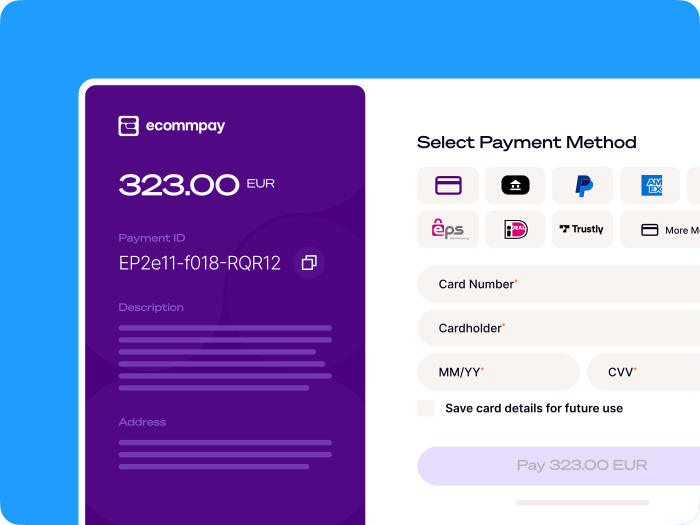
Hosted payment page
For those who want the absolute minimum technical overhead, a hosted payment page is the answer. When your customer is ready to pay, they are redirected to a secure, Ecommpay-hosted checkout page that is fully optimised for mobile and desktop. This reduces your PCI compliance burden and ensures that you are always using the latest, most secure version of the payment gateway without having to manually update your site.
Take control of your payments
So, how easy is it to switch or add a payment provider? In the current market, it is a strategic move that is well within the reach of any UK small business. You don't have to be a tech expert to enjoy lower fees, better uptime, and more payment options.
By adding a provider like Ecommpay as a secondary option, you can test a new payment provider with minimal disruptions to your existing operations. Once you see the speed of our onboarding, the ease of our plugins, and the impact of lower processing fees, you might find that "switching" is one of the most impactful business decisions you make this year.
Don’t let the fear of a "difficult" process hold your business back. Your payments should be an engine for growth, not a hurdle to overcome.
This article is for informational purposes only and does not constitute financial advice. Small businesses should conduct their own due diligence before selecting a payments platform.