Our new podcast episode is here – search for Making payments make sense on Spotify! Listen now
Core Functionalities

Authorisation optimisation

  • Improve payment authorisation rates by implementing a payment optimisation solution tailored to your business needs
  • Enhance your payment processing capabilities with our smart payment routing gateway, based on real-time data
  • Leverage our technical expertise and professional insights to streamline the right balance between optimising the authorisation rate and minimising fraud
Increase authorisation rates
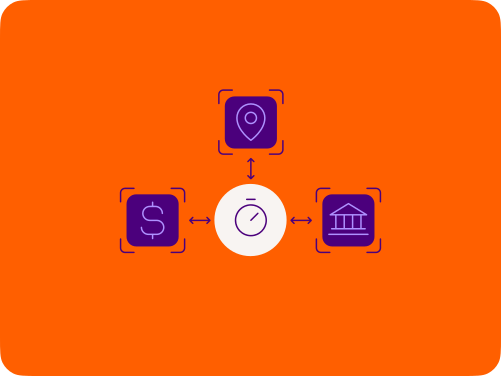
Our flexible, dynamic smart routing payment gateway instantly reviews relevant factors such as location, issuing bank, and transaction value, implementing additional optimisation features to improve payment authorisation rates and reduce shopping cart abandonment. Our dedicated tools and functionality, coupled with expert knowledge ensure payments are configured correctly, resulting in the highest likelihood of successful transaction processing.

Not all declines are the same. Each one points to a different opportunity to improve performance.

You know exactly how much revenue your business generates. Fewer businesses know how much of it disappears through unsuccessful payments, or how much they could win back with a smarter approach to authorisation.
Authentication friction
Issues within 3DS or the authentication journey that stop customers from completing payment.
Customer behaviour
Insufficient funds, incorrect details, abandoned attempts or payment timing.
Fraud and risk controls
Rules designed to protect the business that may also affect legitimate transactions.
Issuer decisions
Declines made by card issuers based on their own approval criteria.
Technical and operational factors
Integration issues, data quality, system configuration or processing errors that affect transaction success.

What if more of your declines could become approvals?

See how optimisation has delivered results

A review of the merchant’s payment journey uncovered avoidable integration issues. Following implementation of the recommended changes, the approval rate increased from 72.9% to 93.9%.

Analysis identified an opportunity to introduce an alternative authentication route for eligible transactions. Following implementation, the approval rate increased from approximately 42% to more than 50%.

A detailed review uncovered a technical issue within the authentication flow that was affecting transaction completion. Once resolved, the approval rate increased from approximately 64% to 72%.

A review identified missing or incomplete transaction data that could affect issuer decisioning. After the merchant enriched the data submitted with payment requests, the approval rate increased from 62.8% to 67.7%.

Discover documentation of our cutting-edge solutions

Our payment products are built for ease of use. Say goodbye to complexity and hello to seamless transactions

Most providers report on payment performance. Our team investigates it.

Our Merchant Performance Optimisation team combines payment analytics, issuer intelligence, authentication expertise and transaction-level investigation to find out where revenue is being lost, and how to recover it.
Identify opportunities
We analyse the full transaction journey: logs, authentication and 3DS data, issuer performance, customer behaviour, fraud controls and data quality.
Remove friction
We work through the technical, operational and behavioural factors involved, from flow structure and integration setup to challenge ratios, callback exchanges and completion timings.
Improve performance
We turn what we find into a strategy that reduces avoidable declines and recovers revenue you're currently losing.

Power up authorisation and acceptance rates with our smart routing payment gateway

A flexible, dynamic and tailored solution to suit merchants of any size. Let us manage your transaction flow using our technology and expertise for payment optimisation; streamlining the balance between payment authorisation and minimising fraud to increase authorisation rates both regionally and globally. Ready to enhance your payment processing capabilities?

Authorisation optimisation FAQs

Let’s decode the complexity

Providers don’t all measure approval rate the same way. What counts as a transaction varies: some figures include failed authentication attempts or retried transactions, others exclude them. Before comparing approval rates across providers, it’s worth checking exactly what’s included and what’s left out. Otherwise, you may be comparing two different numbers.

A dashboard can show you your approval rate, but it can’t always tell you why it’s what it is, or what you need to do next. Our Merchant Performance Optimisation team investigates the full transaction journey to find where revenue is being lost and puts fixes in place to recover it. Reporting tells you what happened - but investigation tells you why - and what to do about it.

The payment authorisation rate is the percentage of payment attempts that are successfully approved by card-issuing banks. It's calculated by dividing approved transactions by total attempted transactions. This metric directly impacts your revenue – even a 1% improvement in authorisation rates can significantly increase sales. Low authorisation rates mean legitimate customers are being declined, leading to lost revenue and a poor customer experience.

Smart routing automatically directs each payment to the most suitable acquiring bank or payment processor based on real-time performance data. The system analyses factors including card type, issuing bank, transaction amount, customer location, and historical success rates to select the optimal payment path. If the first attempt fails, intelligent retry logic automatically routes the transaction through alternative channels within milliseconds, often recovering payments that would otherwise be lost.

Ecommpay's smart routing engine evaluates multiple parameters, including card financial platform (Visa, Mastercard), issuing bank and country, transaction amount and currency, customer geographical location, merchant category code, time of transaction, and historical performance data. The system also considers real-time factors like processor uptime, response times, and current success rates to dynamically select the best route for each individual transaction.

Ecommpay's smart routing operates in real-time, making routing decisions within milliseconds. The entire process – from initial routing decision through potential cascading attempts – typically completes within 3-5 seconds, ensuring minimal impact on customer checkout experience. The system processes millions of transactions to continuously learn and optimise routing decisions, with machine learning algorithms updating routing preferences multiple times per day.

Payment cascading automatically retries declined transactions through alternative payment processors or acquiring banks within a single payment attempt. When a transaction receives a soft decline, the cascading system immediately routes it to a secondary processor without requiring customer action. This process can continue through multiple backup processors until successful authorisation is achieved.

The number of retry attempts is flexible and can be aligned with your business needs and risk strategy. Unlike a fixed retry count, cascading depends on the availability of alternative payment processors and acquiring banks at the time of the transaction. The system automatically routes declines through the best available alternatives, thereby ensuring efficiency and optimal approval rates without unnecessary attempts.

No, cascading happens automatically in the background without customer awareness. The entire cascading process typically completes within 50 milliseconds, which is faster than manual retry attempts customers might make themselves. From the customer's perspective, they submit payment details once and receive a final result – either successful approval or a legitimate decline. This seamless experience actually improves customer satisfaction compared to failed payments requiring manual retries.

Yes, Ecommpay's cascading system includes intelligent decline code analysis that determines the optimal retry strategy for each specific failure reason. For example, ‘issuer unavailable’ errors are immediately retried through alternative processors, whilst ‘transaction limit exceeded’ might trigger routing to processors with higher limits. The system maintains a comprehensive database of decline code meanings and appropriate retry strategies to maximise recovery rates.

Network tokenization replaces sensitive card details with unique tokens issued by card networks (Visa, Mastercard). These tokens provide additional transaction context to issuing banks, reducing false declines. Network tokens are automatically updated when underlying card details change (new expiry dates, replacement cards), preventing failed transactions from expired cards. The enhanced data visibility helps banks make more informed authorisation decisions, particularly for recurring and stored credential transactions.

Yes, Ecommpay automatically requests network tokens for eligible stored card transactions when supported by the card network and issuing bank. The tokenization process is transparent to both merchants and customers – existing stored cards are gradually migrated to network tokens during normal transaction processing. This seamless implementation ensures immediate benefits without requiring system changes or customer re-enrollment.

3D Secure (3DS) authentication can both improve and, in some cases, reduce authorisation rates. Ecommpay's intelligent 3DS system optimises authentication requests by applying exemptions where possible and using 3DS 2.0 frictionless flows to maintain high approval rates whilst meeting regulatory requirements like PSD2.

It’s also important to note that if a transaction fails at the 3DS authentication stage, no new payment attempt will be created. Cascading only applies after an authorisation request has been sent to a payment processor and receives a soft decline (for example, due to a technical issue or timeout error). A failed 3DS step means the payment never reaches authorisation, so retrying through alternative processors would not be possible or effective.

Implementation typically takes one to two business days, depending on your routing and cascading scheme complexity. For businesses using Ecommpay's hosted payment pages or API integration, optimisation features are often available immediately with configuration adjustments. More complex implementations involving multiple existing processors or custom routing rules may require additional integration time. However, many optimisation benefits (smart routing, cascading) can be activated progressively during the implementation process.

Authorisation rate improvements vary based on your current setup. The exact uplift depends on factors like your industry, current processors, geographical markets, and transaction characteristics. We provide detailed projections during implementation planning.

Yes, Ecommpay's authorisation optimisation includes flexible rule configuration for business-specific requirements. You can set custom routing preferences based on transaction value, customer type, geographical location, or any combination of factors. For example, you might route high-value transactions to your most reliable processor whilst optimising smaller transactions for cost efficiency. The system supports complex business logic whilst maintaining automatic optimisation capabilities.

Recurring payment authorisation benefits significantly from optimisation features. Network tokenization automatically updates card details, preventing declines from expired cards. Smart routing learns which processors perform best for specific subscription customers and transaction patterns.

Yes. Ecommpay's authorisation optimisation can work alongside your existing payment processors through our orchestration platform. To make an external payment processor available via Ecommpay's API, we’ll first need to integrate it into the platform. Once integrated, you can maintain your current processor relationships whilst adding intelligent routing and cascading capabilities. Transactions can then be routed between Ecommpay's direct acquiring and your existing processors based on optimal performance criteria, giving you the best of both worlds.

Search result tabs

Searching...